
Work with what’s happening
Improvisation
Improvisation is not an art form in itself. It is a way of working, a discipline of attention, action and creative responsiveness. For some, it means performance games or a weekly social activity. For others, it becomes a craft — a method of composing in real time with the body, the imagination and the reality of the moment.
Impro Supreme belongs to the second category.
What interests me is improvisation as a serious creative practice: not the fast, clever version built on verbal reflexes, but the deeper work of choice, clarity and presence. Improvisation that begins in the body, unfolds through purposeful attention, and leads to something real and alive on stage.
Why improvisation matters
Improvisation trains the ability to create from what is actually happening — not from preconceived ideas, templates or automatic habits. It asks the performer to notice, to choose, and to act with clarity. When practiced seriously, it becomes a discipline that strengthens all performance work, scripted or unscripted.
What the audience sees should be nothing less than the living embodiment of your creative mind in action.
That requires attention, physical presence and the courage to work with reality instead of imagination alone.
Improvisation is technique: awareness that becomes action.
How Impro Supreme approaches improvisation
In my work, improvisation begins in the body — in sensation, feeling and physical presence. You train yourself to notice what you are doing, understand how it reads, and compose from that reality. The imagination is not a separate layer. Neither is emotion. Both arise from the body’s shifts, tensions, rhythms and impulses, and they shape the direction of the moment.
Improvisation becomes a physical–attentive practice:
clear actions, simple perceptions, and felt emotional tones. From there, choices can become precise, readable and meaningful — not because they are planned, but because they grow out of the physical and felt reality of the moment.
This is where theatre appears.
Once you truly engage with sensation and feeling, the work naturally generates relationships, atmosphere, character, narrative direction — not through invention, but through interpretation.
This approach trains a way of creating that stays rooted in perception rather than speed or habit.
Improvisation, in this sense, becomes a form of embodied theatrical composition that strengthens all stage work, whether scripted or not.
Articles and writings
Insights into improvisation as embodied creative work — from practical details to broader principles.
- Improv emotions: what improvisers really feel
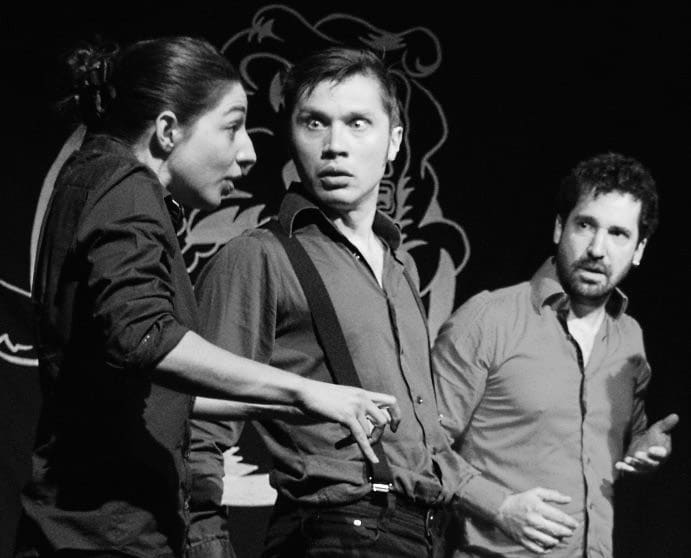 A practical mini-dictionary of improv emotions that uncovers what improvisers really feel on stage – and how those feelings shape their improvisation.
Go further
Explore how this work translates into training and practice.